


What Is a Masala Dabba?
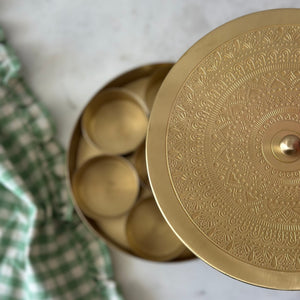
A masala dabba is a round spice box, traditionally made from brass or steel, that holds six or seven small bowls inside a single lidded container. It is the way Indian kitchens have stored everyday spices for generations. Not in a rack. Not in individual jars. Everything together, within arm’s reach, opened with one hand while the other stirs the pot.
The word “dabba” simply means box. “Masala dabba” is a spice box. But it is also, if you have cooked with one, a kind of shorthand for an entire way of working in the kitchen: organised, intuitive, unhurried.

What goes inside a masala dabba
There is no single correct answer to this. Every household has its own lineup, shaped by region, family, and whatever gets used most that week. But a good starting point for a seven-bowl dabba looks something like this: Turmeric (haldi). Cumin seeds (jeera). Mustard seeds (rai). Red chilli powder (lal mirch). Coriander powder (dhaniya). Salt (namak). And one bowl left open for whatever you reach for next, whether that is asafoetida (hing), fennel seeds (saunf) or something else entirely.

The point is not to follow a fixed template. The point is to build a system that matches how you actually cook. Some people swap coriander powder for curry leaves. Others keep a bowl of nigella seeds because they use them in every dal. Some mix black pepper pods, cloves, and cardamom. The dabba adapts to you, not the other way around.
Why brass
Masala dabbas come in steel, copper, and wood. We make ours in brass, and there is a reason for that beyond how it looks on the countertop.

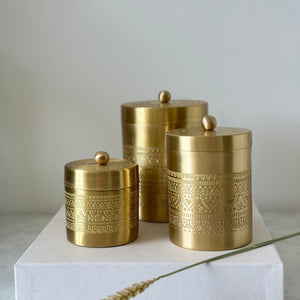
Brass is dense and durable, and it ages well. It darkens with use and polishes back to a shine. The metal also has a long history of use in Indian food storage, going back well before modern kitchen organisation became an industry. It was chosen for practical reasons first, and it has lasted because those reasons still hold.
Our brass masala dabba is handcrafted in Moradabad, Uttar Pradesh, the brass capital of India. The artisans who make these pieces have been working with this metal for generations. Each box is shaped, hammered, and finished by hand. No two are perfectly identical, which is part of the appeal and part of the honesty.

How to actually use one
Place it next to the hob. That is the first and most important instruction. A masala dabba that lives in a cupboard is just a pretty container. One that sits within arm’s reach while you cook changes the rhythm of your kitchen.
Most Indian cooking starts with a tadka: oil in a hot pan, then a quick succession of whole and ground spices added in a specific order. With a dabba open beside you, that sequence becomes muscle memory. Cumin seeds go in first. Mustard seeds follow. You do not break stride to open three separate jars.
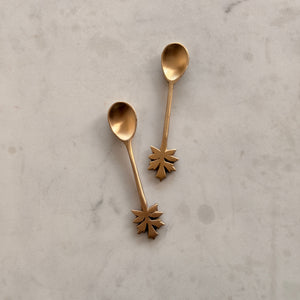
A small spoon usually sits inside the dabba, resting on top of the bowls. Use it to measure loosely. Cooking from a dabba is not about precision. It is about feel, built up over dozens of meals until you stop thinking about quantities altogether.

Keeping it in good shape
Brass develops a natural patina over time. Some people love it. If you prefer the shine, a paste of Pitambari powder and water, rubbed gently in circles, will bring it back in minutes. We have a full brass care guide if you want the detailed version.
The main thing: keep the bowls dry before refilling. Moisture is the enemy of ground spices, and a quick wipe with a dry cloth after washing is all it takes to keep everything fresh. What reacts with brass can vary. If you are ever unsure about something, keep it out of the dabba.

A note on choosing the right size
A standard masala dabba is 8 inches in diameter. That is enough for seven bowls of a practical size, each holding roughly two to three tablespoons of ground spice. It works for daily cooking in a household of any size.
If your counter space is tight or you cook less frequently, a 6-inch mini dabba holds fewer bowls but takes up about the same space as a side plate. It is a good entry point if you are not sure whether the system will work for you. (It will.)

The case for owning one
A masala dabba is not a gadget. It does not have settings or attachments or a manual. It is a simple, well-designed object that solves a real problem: how to keep your most-used spices accessible, organised, and together without cluttering the kitchen with a dozen individual containers.
It is also, for what it is worth, the kind of object that travels well across generations. A brass dabba bought today will outlast every spice rack, turntable, and magnetic jar system currently on the market. Not because brass is indestructible, but because good design does not go out of fashion, and a round box with seven bowls inside it is about as good as kitchen design gets.


