
Stone of the Taj
Makrana Marble
The same quarry. The same marble. Now for your home. In 1632, Shah Jahan chose Makrana for the Taj Mahal. It has not yellowed since. Neither will your piece.
Explore the CollectionEvery home deserves a stone with a story.
The Collection
Five Pieces, One Stone
Each handcrafted by hereditary marble artisans in Agra.


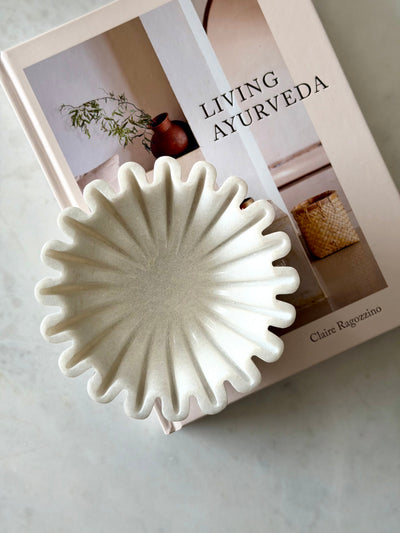
Hand-Carved Makrana Marble Ruffled Urli
£49.00
View Product

Hand-Carved Makrana Marble Flower Plate
£21.00
View Product

Makrana Marble Diyas with Brass Katori
£21.00
View Product

Makrana Marble Inlay Dish with Stone Inlay
£21.00
View Product

Makrana Marble Coasters with Stone Inlay
£35.00
View ProductHow to Style It
Marble belongs in every room.
Each piece earns its place differently. Here is how they live in a home.
The Ruffled Urli
Coffee Table · Console · Bookshelf
Stack it on your favourite book. Float a few flowers. Serve pistachios. Leave it empty, the shape does the work.
Inlay Dish & Flower Plate
Bathroom · Dresser · Festive Table
Place by the door for keys. On the bathroom shelf for soap. On the dresser for rings. On the table for olives. Under the tea lights for festivals, it works everywhere.
Diyas & Coasters
Mantle · Island · Puja Corner
With morning chai or evening wind down, these pieces are already part of your day. They just look better now.
One of only two marbles in the world classified as a Global Heritage Stone. Its geological rarity and cultural significance are considered irreplaceable.
The Stone
Most marble ages. Makrana does not.
Most marble is porous. It absorbs water, stains over time, and slowly yellows. Italian Carrara, the marble used in most luxury homes, needs regular sealing and still shifts colour over the decades.
Makrana is different. Its calcium content is 98% pure. Water cannot penetrate it. It needs no sealing, no special treatment, and no maintenance beyond a damp cloth.
That is, after all, why Shah Jahan chose it for the Taj Mahal nearly four centuries ago.
Care
Caring for Your Marble
Simple care. Long life.
Daily Care
Wipe with a soft, damp cloth. Dry immediately. That is all it needs.
What to Avoid
Acids will stain marble. Keep citrus, vinegar, and harsh chemical cleaners away from the surface. Avoid abrasive scrubbers and dishwashers. If something acidic spills, wipe it off immediately. Gentle and traditional is the way.
The same families. The same techniques. Used on the Taj Mahal. Used on your piece. What you are holding is not an homage to that tradition. It is a continuation of it.
The Craft
Three crafts behind the collection.
The artisans who make your piece practise crafts that have been passed down through families in Agra for generations that predate the Mughal Empire.
Hand Carving
Each piece begins as a raw block of Makrana marble and is shaped entirely by hand. The ruffled edge of the urli, the curve of the flower plate, the hollowed base of the diya. No moulds. No machinery. The artisan works the stone by feel, drawing on knowledge inherited through generations. No two pieces are identical because no two hands move the same way.
Brass Inlay
Thin strips of solid brass are heated, bent by hand, and pressed into channels carved into the marble surface. The brass sits flush with the stone, creating patterns that catch light without breaking the surface. It is a technique that requires precision measured not by instruments but by experience.
Parchin Kari
Known in Italian as Pietra Dura, this is the art of stone inlay. Semi precious stones are cut by hand into slivers thin enough to carry light: lapis lazuli, malachite, cornelian, mother of pearl. Each sliver is fitted into a channel engraved into the marble. No adhesive shows. No joint is visible. The stone simply becomes pattern.